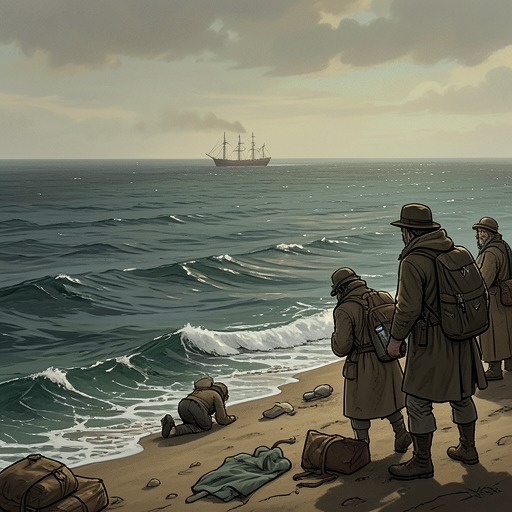
Theirs was a voyage which people took only once
The Emigrants“Theirs was a voyage which people took only once” names the decisive transformation at the heart of the emigrants’ crossing: a journey undertaken for the promise of land becomes an irrevocable departure from home. The phrase gathers the hopes, calculations, family disagreements, and hardships that carry the group from Ljuder Parish to New York, while making the immense ocean itself the measure of their separation.
From Restlessness to Departure
The crossing begins before anyone boards a ship. News of fertile land travels through peasant communities where plots are shrinking as families grow, and where scarcity and inherited customs have long defined daily life. Rumor and printed accounts make America imaginable, but not verifiable: the ocean remains forbidding, and the proposed destination is unknown to those considering the journey. Some hesitate while others dare, with disagreements dividing generations and, within households, husbands and wives. The movement gathers momentum through such individual decisions rather than from one shared motive.
The group from Ljuder Parish represents that diversity. Its members are moved by crop failure, religious persecution, dissent, personal troubles, social ostracism, and unfair employment practices. For Karl Oskar Nilsson, emigration is an answer to a home farm that has brought four years of toil and deeper debt without improving his prospects. Remaining at Korpamoen seems to promise only exhaustion and, in old age, a place in the reserved room with meager bread. Kristina, by contrast, fears that America may prove a wild-goose chase: no one they know has seen the country, no land deed awaits them, and newspapers and books are not guarantees. Their nightly conversations make the decision a household conflict as well as an economic calculation.
The Journey Made Possible
A resolve to leave becomes a departure only through information, money, permission, and social ties. Karl Oskar and Robert have arranged passage with a firm in Karlshamn, paying one hundred daler in advance for six places aboard the Charlotta. Spring is chosen so the emigrants can arrive in time to till and sow for a fall harvest; the ship is due to leave in April and sail directly to New York. Robert offers to secure a contract for Danjel as well, if there is room. Danjel’s household plans to join, turning one family’s proposed move into a wider undertaking.
Selling Korpamoen exposes the cost of that undertaking. Karl Oskar receives less for the farm than he paid, though scarce cattle bring good prices at auction. After debts and the mortgage are deducted, the family has 1,200 daler; passage for three adults and three children costs 675, leaving about 500 for arrival fees, onward travel, and the tools and cattle needed to begin again. Kristina sews the remaining money into a sheepskin bag that Karl Oskar can wear against his body. The journey’s promise of nearly free land is thus set against the very limited resources with which the family must reach and cultivate it.
The travelers converge at Åkerby Junction. Nineteen people meet there, including three drivers who will return from Karlshamn; the emigrant party itself consists of sixteen people, nine adults and seven children. Danjel arrives with his wife, four children, and Ulrika of Västergöhl; Arvid and Elin travel with Jonas Petter, whose wagon also gives Robert a place beside the driver. Robert and Arvid, once farmhands at Nybacken who had imagined slipping away alone, now travel together as part of a larger company. The gathering makes the migration’s collective character visible without erasing the different routes by which its members came to it.
The Ship as Passage and Confinement
The brig Charlotta sails from Karlshamn on April 14, 1850, bound for New York. Under Captain Lorentz, it carries pig iron and assorted goods as well as seventy-eight emigrants; with a crew of fifteen, ninety-four people are aboard. It is the vessel’s seventh voyage as an emigrant ship. The figures establish the crossing as an organized commercial passage, but they also measure the human crowd carried inside it.
Below deck, canvas divides the hold into compartments for families, unmarried men, and unmarried women. The emigrants spread bedding in berths intended for seventy-eight, among knapsacks, food baskets, tubs, and bundles. The low overhead and thick air make the crowded space oppressive; light comes through the main hatch, and after dark only a few smoking kerosene lanterns illuminate it. There is scarcely room to step between the belongings. Even family arrangements cannot always be kept: Karl Oskar must share a two-man bunk with Robert in the unmarried men’s compartment, with Jonas Petter above them and Arvid nearby. The voyage toward freedom begins in a space where movement and privacy are severely restricted.
A Crossing Without a Way Back
After two months, the emigrants look back across the vast distance they have crossed and confront a new conviction: whatever awaits them in the new land, a return journey is beyond conception. The sea has made the route feel endless, and the thought of crossing it again cannot be entertained. The phrase “Theirs was a voyage which people took only once” therefore describes more than the practical difficulty of return. It gives the migration the shape of a one-way passage, a separation that becomes more certain as the ocean widens behind them.
When the Charlotta reaches New York, the sight of green earth transforms the meaning of that ordeal without undoing it. Storms, illness, confinement, and monotonous days have worn down the passengers; scurvy and ship fever have weakened them, and many have lost heart. Now they crowd onto deck to see the shore. The green trees, grass, and living ground answer the land they have sought, and energy, initiative, and hope return to the sick, tired, and timid. Their arrival offers a beginning, but the remembered homeland lies across an ocean they have already understood as unrepeatable. The phrase holds those two truths together: the voyage brings the emigrants to a hoped-for future by making their former home feel unreachable.